

The Week
Eight days, ending in the dark
Seven nights across Granada, Córdoba, Seville and Algeciras, with photography sessions at every stop, a wildlife outing in the Strait of Gibraltar, and a full technical rehearsal the day before totality.
Everything below is included in the price, with the exception of your flights.
27 July to 3 August 2027.
Málaga to Granada, then Córdoba, Seville, Ronda, and down to the coast at Algeciras.
The first five days are Andalusia at its best: the Alhambra at opening time, the Mezquita, the Alcázar, flamenco in Seville, the gorge at Ronda. They are also preparation. By the time you reach the Strait you will have shot difficult light every day for a week and know exactly what your camera does.
Day six is the Strait itself, birds crossing to Africa and orcas hunting offshore, and then the Eclipse Academy: every setup checked, every sequence rehearsed. Day seven, at 10:47 in the morning, the Sun goes out over the sea for four minutes.
DAY 1 · TUESDAY 27 JULY
Málaga to Granada
We meet you at Málaga airport, whatever time you land. From there it is a ninety-minute drive inland and upward, out of the coastal heat and into the Vega de Granada, with the Sierra Nevada building on the horizon as you climb.
The afternoon is yours to check in, unpack and sleep off the flight. In the evening we gather for the opening briefing: who is who, what the week looks like, what we expect the sky to do, and what each of you wants to come home with. Then dinner, which is where the group actually becomes a group.
Come with questions. This is the easiest evening of the week to ask them.
What you’ll shoot: nothing, and that is deliberate. Day one is for arriving.
Overnight in Granada.
DAY 2 · WEDNESDAY 28 JULY
Granada
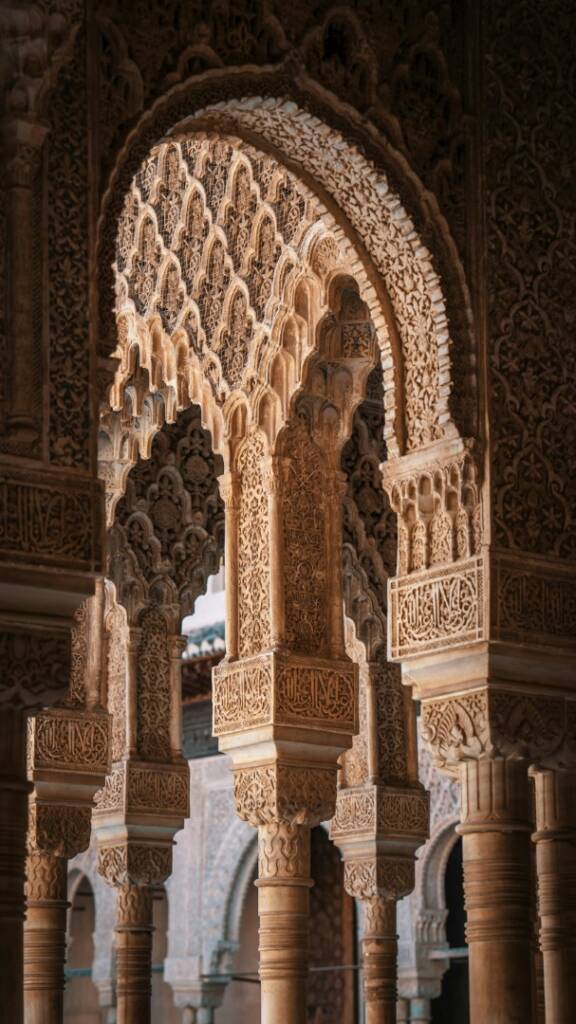
We start early, because the Alhambra is not a building you photograph in the middle of the day. Entry to the Nasrid Palaces runs on timed slots and we take one of the first, when the courtyards are still cool and the crowds have not yet arrived.
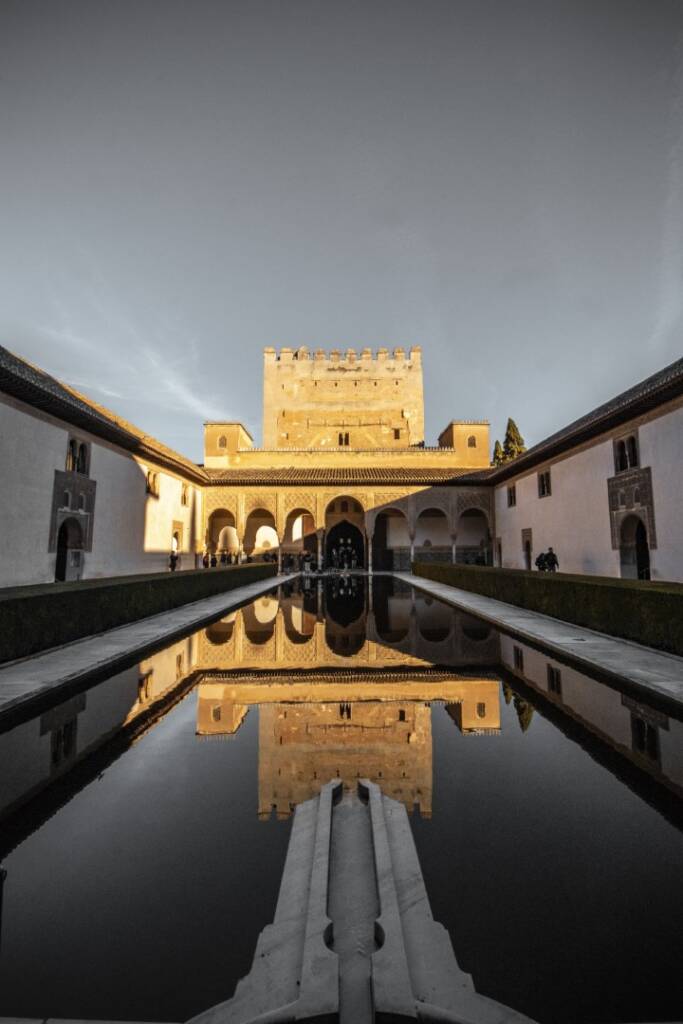
What you are looking at is a set of rooms designed around light. Every screen, every carved plaster wall, every pool exists to break the sun into something else. The Court of the Myrtles will hand you a perfect reflection if you get low enough. The Generalife gardens above are the opposite problem: hard sunlight, deep shade, water everywhere, and a dynamic range that will punish a lazy exposure.
In the late afternoon we cross to the Albaicín, the old Moorish quarter on the opposite hill. Its lanes are narrow and steep and lead, eventually, to the viewpoints that look straight across at the Alhambra with the Sierra Nevada behind it. We stay for sunset, which is when the whole palace turns the colour it was named for.
What you’ll shoot: architecture, geometry, reflections, high-contrast interiors, and one of the most photographed views in Spain, from a position that lets you do something different with it.
Overnight in Granada.
DAY 3 · THURSDAY 29 JULY
Transfer to Córdoba
We transfer to Córdoba in the morning and go straight to the Mezquita, again early. Córdoba in late July is genuinely hot, often the hottest city in Europe on any given day, and the working rhythm here is to shoot at the edges of the day and rest through the middle of it.
Inside the Mezquita there are more than eight hundred columns holding up a double tier of red and white arches, receding in every direction until the room stops behaving like a room. It is one of the hardest interiors in Spain to photograph well: very low light, repeating forms that flatten if you shoot them straight on, and a Renaissance cathedral dropped into the centre of it in the sixteenth century. We will work on finding an angle that does not look like every postcard of it.
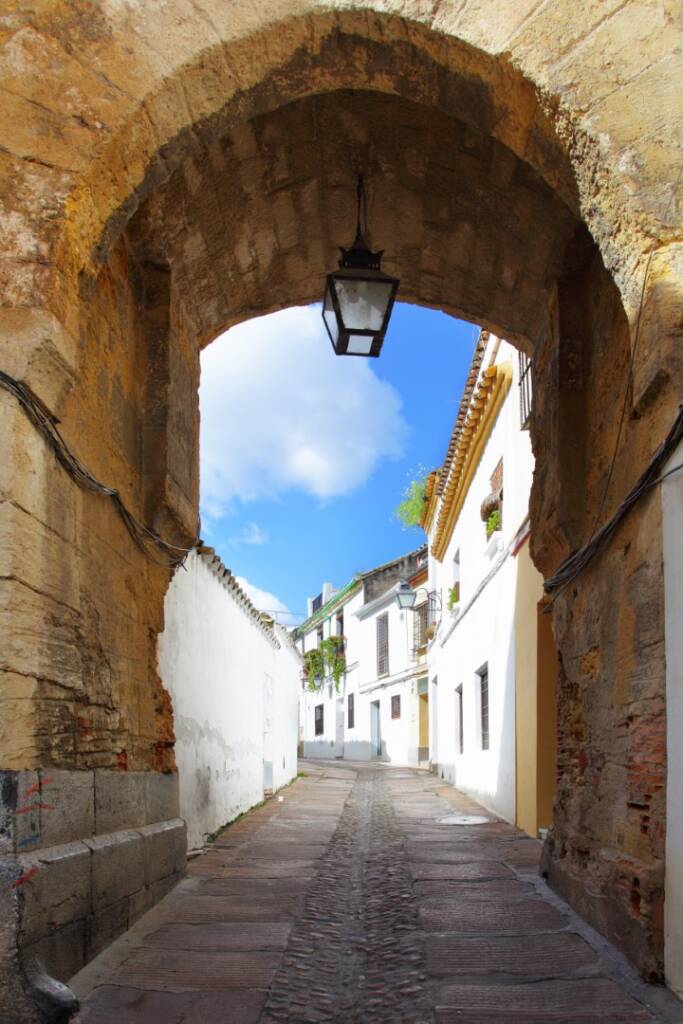
Afterwards, the Judería: whitewashed lanes barely wide enough for two people, geraniums on the walls, and the courtyards Córdoba is famous for. In the evening we walk out onto the Roman Bridge as the light goes, with the Calahorra tower at one end and the Mezquita lit behind you at the other.
What you’ll shoot: low-light interiors, repetition and symmetry, narrow-street detail, and a blue-hour cityscape from the bridge.
Overnight in Córdoba.
DAY 4 · FRIDAY 30 JULY
Transfer to Seville
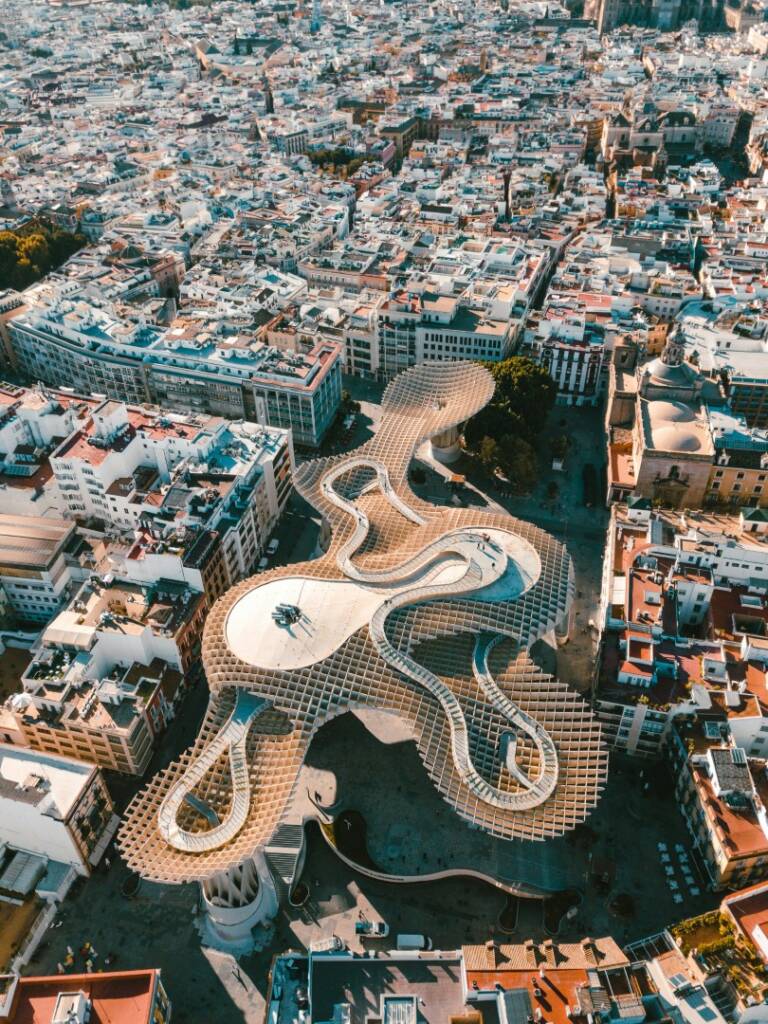
Seville is the largest city on the route and the one with the most to photograph in the least time, so the day is structured tightly.
We begin at the Plaza de España, built for the 1929 exposition and about as theatrical as public architecture gets: a half-kilometre curve of brick and tile wrapped around a canal, with bridges and towers at either end. Early morning gives you it nearly empty and the low sun raking along the colonnade.
Then the Royal Alcázar, still a working royal residence, and a very different proposition from the Alhambra. Where Granada is restrained, the Alcázar is layered: Mudéjar ceilings over Gothic vaults over Almohad foundations, and gardens that keep opening into more gardens. From there it is a short walk to the Cathedral and the Giralda, which spent its first two centuries as a minaret before it became a bell tower.
We finish in Santa Cruz as the heat drops, and the evening is flamenco: a small venue, close to the performers, low light and fast movement. It is a real technical challenge and one of the most rewarding sets of frames you will take all week.
What you’ll shoot: grand architecture, tilework and colour, garden detail, street atmosphere, and low-light performance photography.
Overnight in Seville.
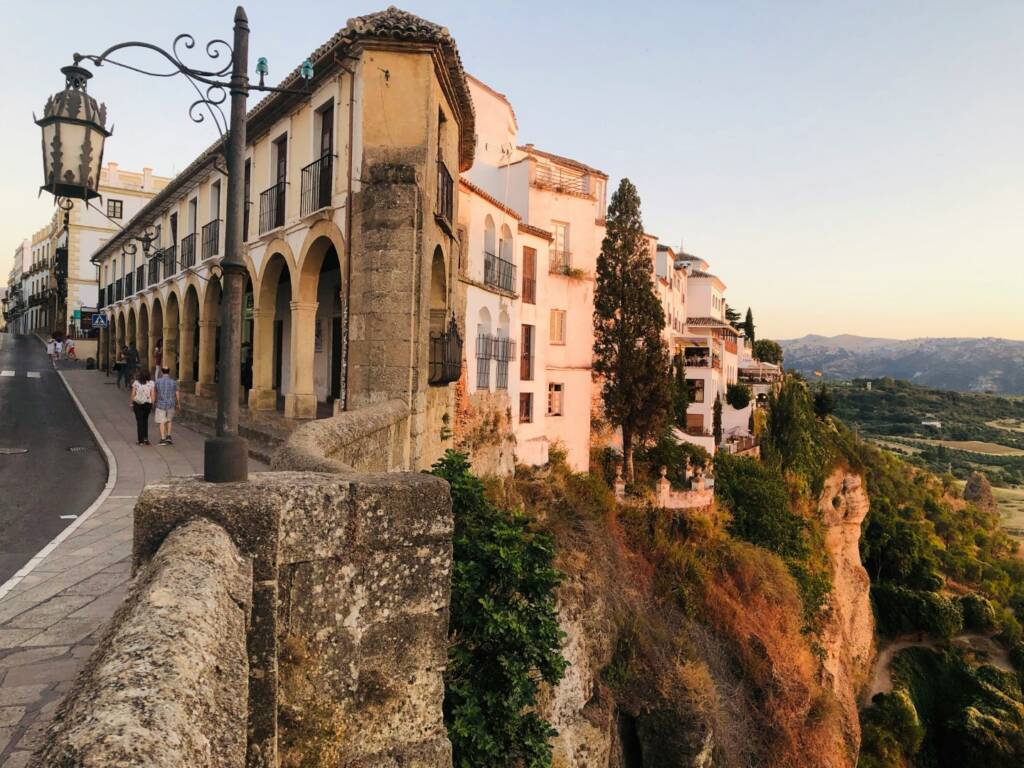
DAY 5 · SATURDAY 31 JULY
Transfer to Ronda
The road from Seville to Ronda climbs into the Serranía and the landscape changes completely: white villages on hilltops, cork oaks, limestone, and far fewer people.
Ronda sits split in half by El Tajo, a gorge a hundred metres deep with the Guadalevín river at the bottom, and the Puente Nuevo thrown across it. Photographing it well means getting out of the town and below the bridge, which we do, because the view everyone knows from above is not the strongest one available.
The old town on the far side is quiet, walkable and full of viewpoints looking out over the plain. We stay through the afternoon light, and then drive south as the day cools, down out of the mountains and across to Algeciras on the Strait. You will see the Rock of Gibraltar and, on a clear evening, the mountains of Morocco across the water.
This is where the trip changes gear. Everything from here is about the eclipse.
What you’ll shoot: dramatic landscape, scale, the gorge from below, white-village detail, and your first sight of Africa.
Overnight in Algeciras.
DAY 6 · SUNDAY 1 AUGUST
Strait of Gibraltar and Eclipse Academy
Morning: out on the water.
The Strait of Gibraltar is fourteen kilometres wide at its narrowest and functions as a funnel for two entirely different kinds of traffic. Overhead, early August is the beginning of the southbound migration: black kites, honey buzzards, short-toed and booted eagles, Egyptian vultures and white storks, circling up on thermals over the Spanish side and then gliding across to Africa.
Below, the water is one of the richest cetacean sites in Europe. Common, striped and bottlenose dolphins are seen year-round, along with long-finned pilot whales and sperm whales. And through July and August a small resident group of orcas works the Strait hunting bluefin tuna, which is behaviour you can watch in very few places on Earth. We take a boat out for the morning to look for them.
Nothing at sea can be promised. Conditions in the Strait change fast and the levante wind decides a lot. But the timing is right, and the odds are as good as they get.
Afternoon: the Eclipse Academy.
This is the part of the week that separates a good eclipse photograph from a missed one, and it is the reason we build a whole afternoon around it.
We start with theory: what happens minute by minute, what each phase demands, and where people typically lose the shot. Then we go hands-on with your equipment specifically. Every camera and telescope is set up individually. Solar filters are checked and fitted. Shooting sequences are built and programmed. We then run a full rehearsal of the eclipse session in real time, so that the sequence you will execute tomorrow is one your hands have already been through once.
Every participant’s setup is validated before we finish. Nobody walks to the observation point the following morning still deciding what to do.
What you’ll shoot: birds in flight, cetaceans from a moving boat, coastal landscape, and a full dry run of the eclipse sequence.
Overnight in Algeciras.
DAY 7 · MONDAY 2 AUGUST
Eclipse day
We are at the observation point on the coast near Tarifa well before first contact, with time to set up without rushing and to settle.
At 09:40 the Moon touches the edge of the Sun. For the next hour very little appears to happen, and then, gradually, everything does. The light goes strange before it goes dim: shadows sharpen, the colour temperature slides, and the temperature itself starts to drop. Look at the ground under a tree and you will find hundreds of crescent suns projected through the gaps in the leaves. In the final minutes the shadow becomes visible coming across the water from the west, and the horizon goes the colour of a sunset in every direction at once.
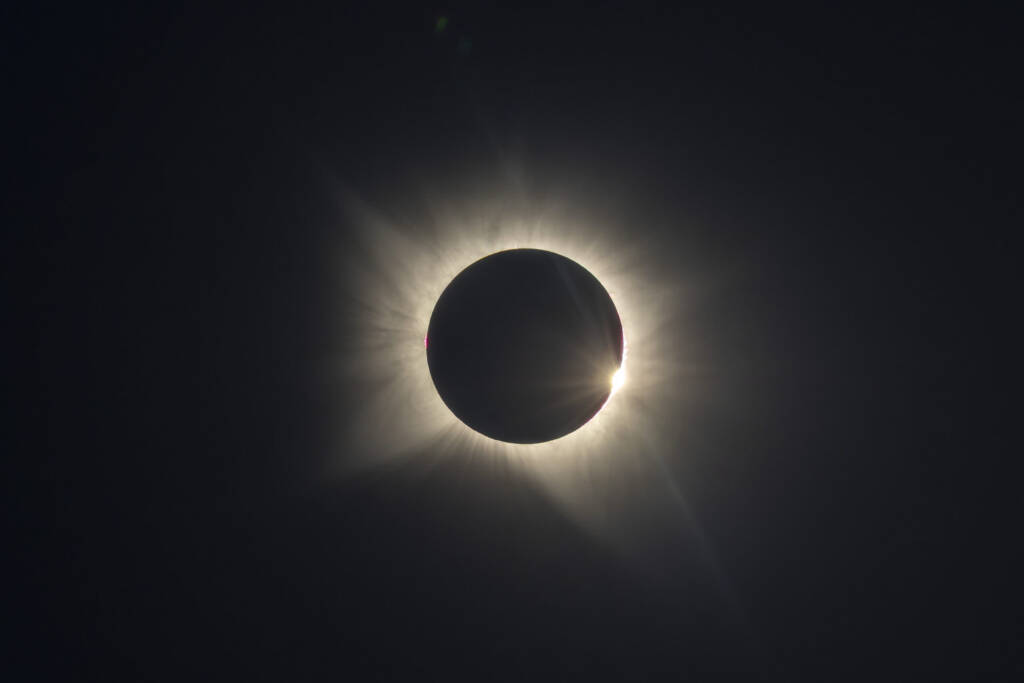
At 10:45 the last of the photosphere disappears and the corona comes out. It is not like a photograph of a corona. It is enormous, structured, and silver, and it hangs over the Strait with Africa underneath it.
You have over four minutes. That is a long totality, one of the longest visible from land this century, and it is enough time to execute your sequence and still stop and look at it, which you should. Our team is on the line throughout, covering the transitions and dealing with anything that goes wrong so that you do not have to.
At 10:49 the diamond ring returns on the other side, and it is over.
In the afternoon, once everyone has come back down, we choose as a group: a processing session on the images you have just taken, or a photographic outing along the coast and into the Strait Natural Park.
What you’ll shoot: partial phases, Baily’s beads, the diamond ring, the corona and prominences, and the landscape under an eclipsed sky.
Overnight in Algeciras.
DAY 8 · TUESDAY 3 AUGUST
Departure
Breakfast, and transfer back to Málaga airport for your flight.
You will leave with a memory card that has the Alhambra at dawn, a flamenco stage, a gorge in the Serranía, an orca in the Strait, and a corona over the sea, all inside eight days. And with a group of people who were standing next to you when the last one happened.
We hope to see you again…
Included
✅ Reception and welcome at Málaga airport, transfer in private vans to Granada.
✅ 7 nights of accommodation in carefully selected hotels in Granada, Córdoba, Seville and Algeciras.
✅ All meals from the welcome dinner on July 27th to breakfast on August 3rd.
✅ Introductory talk.
✅ All the theoretical sessions described on eclipse, landscape and night photography.
✅ All practical photography sessions described, visiting different photographic spots during the trip.
✅ The complete Eclipse Academy: individual setup of cameras and telescopes, full gear review, shooting sequence configuration, a complete eclipse simulation and individual validation of every participant’s equipment.
✅ Photographic advice from two world-renowned experts such as LUIS MIGUEL AZORÍN and NÉSTOR RODÁN.
✅ Guided visits and tickets to the Alhambra and the Generalife, the Mosque-Cathedral of Córdoba and the Royal Alcázar of Seville.
✅ Visit to the historic centre of Ronda, the Puente Nuevo and El Tajo gorge.
✅ A live flamenco show in Seville.
✅ Full day excursion for landscape and wildlife photography in the Strait of Gibraltar Natural Park, including migratory bird photography and a boat trip for cetacean watching (subject to weather and availability).
✅ Special meals in renowned Andalusian restaurants.
✅ Full technical assistance from our team during the eclipse.
✅ All transfers during the tour.
✅ Zero Expeditions guides assistance.
✅ Transfer back to Málaga airport.
Not included
❌ International flights.
❌ Any meal not included previously or alcoholic drinks.
❌ Anything not included in the included section.
Jul 27 to
Aug 3, 2027
Total Solar Eclipse over the Strait of Gibraltar
— Departs and returns from Málaga · 20 places
— a total span of 2 hours, 19 minutes and 51 seconds.
